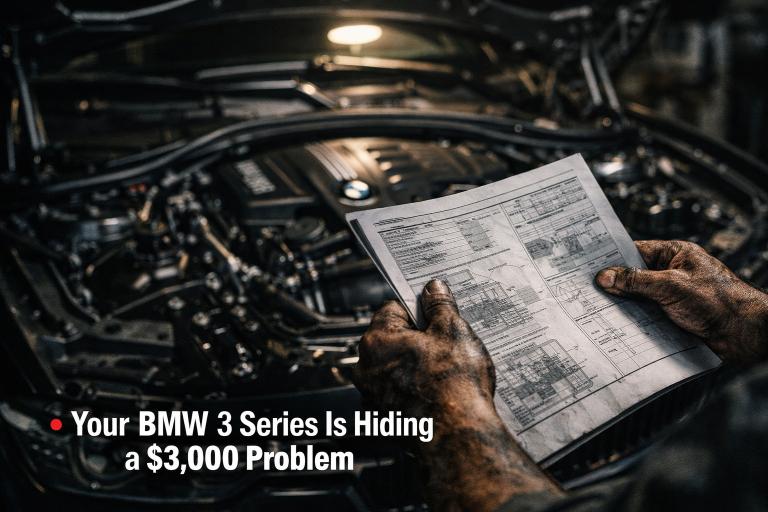
Why the BMW 3 Series Develops These Problems
The BMW 3 Series — spanning the E90 (2005–2011), F30 (2012–2018), and G20 (2019–present) — represents some of the most technically sophisticated mass-market engineering in the automotive world. That sophistication is exactly what makes these cars exceptional to drive and expensive to repair when things go wrong.
Unlike simpler vehicles where components fail independently, BMW systems are deeply interconnected. A failing coolant pump doesn’t just cause overheating — it can trigger cascading faults across the DME, trigger limp mode, and confuse inexperienced diagnosticians into replacing unrelated parts. Understanding why a system fails matters as much as knowing what failed.
The Most Common BMW 3 Series Problems — With Real Repair Data
1. Engine Oil Leaks
The single most reported issue across all three generations. BMW’s use of magnesium and plastic composite valve covers, paired with gaskets that degrade under thermal cycling, makes oil leaks almost inevitable past 60,000 miles on E90 and F30 models. The N52 and N54 engines are particularly known for valve cover gasket and oil filter housing gasket failure.
- Burning oil smell after driving
- Smoke from the engine bay
- Oil spots under the car
- Faster-than-expected oil consumption
- Valve cover gasket failure
- Oil filter housing gasket wear
- Crankshaft seal degradation
- Rear main seal on high-mileage units
2. Cooling System Failures
BMW cooling systems on the E90 and F30 use plastic expansion tanks, electric water pumps (on the N20/N26), and thermostats that are notorious for premature failure. An overheated BMW 3 Series engine can suffer warped cylinder heads or cracked blocks — damage that can cost more than the car is worth. This is one issue where early diagnosis pays for itself many times over.
- Temperature gauge climbing toward red
- Coolant warning light
- Sweet smell from engine bay
- Sudden loss of cabin heat
- Electric water pump failure (N20)
- Expansion tank crack
- Thermostat stuck closed
- Coolant hose failure
3. Timing Chain Problems (F30 N20 Engine)
This is the F30’s most serious known defect. The N20 and N26 four-cylinder engines used a timing chain tensioner prone to premature wear — a defect BMW acknowledged through extended warranty coverage in some markets. When the chain stretches or jumps, the engine will not run correctly. If it snaps, you are looking at catastrophic engine damage with no economical repair path.
- Rattling noise at cold startup (front of engine)
- Engine misfires or rough idle
- P0017 / P0016 fault codes
- Check engine light
- F30 328i / 320i (N20 engine)
- F30 328i xDrive
- 2012–2015 build dates most at risk
- Check VIN for existing BMW coverage
4. Transmission Problems (ZF 8-Speed and DCT)
The ZF 8-speed automatic used across F30 and G20 models is fundamentally a robust unit — but it is sensitive to fluid condition. BMW’s factory “fill for life” designation for transmission fluid has been widely disputed by independent technicians; contaminated fluid is responsible for the majority of shifting complaints on higher-mileage 3 Series models. The DCT (dual-clutch) on M Sport variants has its own adaptation issues when clutch wear reaches threshold.
- Jerking or hesitation between gears
- Harsh downshifts under load
- Delayed engagement from stop
- Transmission warning light
- Degraded ATF fluid (primary cause)
- Solenoid wear
- Mechatronic sleeve failure
- DCT clutch pack wear
5. Electrical Faults and Sensor Failures
Modern BMW 3 Series models run a complex CAN bus network connecting dozens of control modules. When a sensor fails or a module develops a fault, the symptom can appear completely unrelated to the actual cause. This is where uninformed diagnosis gets expensive fast — replacing a $400 part that doesn’t fix the underlying $30 sensor failure is a common story at independent shops without access to factory-level diagnostic data.
- Unexplained battery drain (IBS failure)
- Random warning lights, no clear cause
- MAF sensor / O2 sensor codes
- Comfort access or window malfunctions
- Fault codes don’t always indicate the failed part
- Diagnosis requires factory wiring data
- Shops charge $150–$300 for diagnosis alone
- Misdiagnosis is common without OEM data
BMW 3 Series Repair Cost Comparison
| Problem | Most Affected | Dealer / Shop | DIY Cost | DIY Difficulty |
|---|---|---|---|---|
| Engine oil leak (gaskets) | E90, F30, G20 | $300 – $1,200 | $40 – $180 | Moderate |
| Cooling system (pump / thermostat) | E90, F30 | $500 – $1,500 | $80 – $320 | Moderate |
| Timing chain (N20 tensioner) | F30 (2012–2015) | $1,000 – $3,500 | $250 – $600 | Advanced |
| Transmission fluid service | F30, G20 | $300 – $600 | $90 – $160 | Easy–Moderate |
| Electrical diagnosis + sensor | All models | $200 – $1,500+ | Part cost only | Varies |
Most BMW repair bills aren’t expensive because the parts are expensive. They’re expensive because diagnosis is uncertain, procedures are complex, and labor time climbs when a technician is working without complete factory data. Owners who go in knowing the exact cause, the correct part number, and the precise procedure negotiate from a completely different position — or skip the shop entirely.
How a BMW Workshop Manual Changes the Equation
There’s a significant gap between a general repair guide and a factory OEM workshop manual. Haynes and aftermarket guides summarize procedures; factory manuals document them with full wiring schematics, exact torque values for every fastener, ECU coding requirements after component replacement, and model-year-specific variations that generic guides routinely miss.
For a BMW 3 Series owner, that difference shows up in outcomes: a cooling system bled incorrectly because the procedure wasn’t followed exactly leads to air pockets, overheating, and a repeat repair. A timing chain tensioner replaced without the correct cam locking tool spec leads to misfires and potential engine damage. The factory data eliminates those outcomes.
What the BMW 3 Series Factory Workshop Manual Includes
- Complete step-by-step repair procedures for all systems
- Full OEM wiring diagrams for every circuit
- Exact torque specifications for every fastener
- Engine-specific procedures for N52, N54, N20, B48
- Troubleshooting flowcharts — not symptom guesswork
- Same documentation used by BMW dealerships
- Covers E90, F30, and G20 generation variants
- Instant PDF download — searchable and printable
Factory OEM documentation · Instant download · E90 · F30 · G20 available
The Smartest Move Before Any BMW Repair
The BMW 3 Series is one of the most rewarding cars to own and one of the most punishing to maintain without the right information. The problems above are not random — they follow patterns across generations, they have documented causes, and they have documented fixes. The owners who keep their running costs low are not necessarily the ones with the most mechanical experience. They’re the ones who researched the problem thoroughly, understood the correct procedure, and either did the work confidently or walked into a shop knowing exactly what needed to happen.
Whether you’re diagnosing a fault yourself, validating a mechanic’s quote, or planning a preventive service before a problem develops — factory-level documentation is the one resource that changes every outcome that follows.
Explore the full BMW workshop manual library at WorkshopManualsOnline.com — covering E90, F30, and G20 variants with instant download access.